
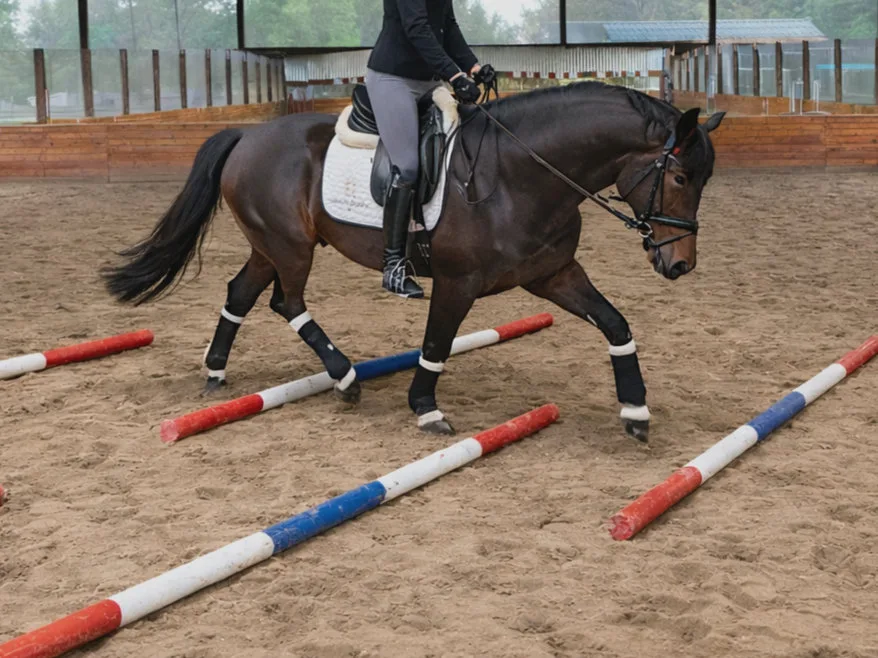
Getting veterinary clearance to return to work after an illness or injury brings immense relief, but for many horse owners, it also brings a wave of anxiety. Hearing that your horse is "cleared for work" is a crucial milestone, but it rarely comes with a step-by-step roadmap for rebuilding the strength, posture, and coordination required under saddle.
Without a structured plan, returning to work can inadvertently trigger compensatory movement patterns or risk re-injury. By integrating classical dressage and equine biomechanics into your horse’s rehab plan, you can bridge the gap between clinical healing and ridden soundness.
Veterinary clearance
Neuromuscular re-education
- In-hand lateral flexions
- In-hand yield of the haunches
Thoracic sling activation
- Raised cavaletti
- Controlled slope work
Ridden rehabilitation
- Biomechanical alignment
- Progressive conditioning
The "vet clear" milestone is a starting line, not the finish line
When a veterinarian issues clearance, it typically means the injured tissue, whether a tendon, ligament, or joint, has healed sufficiently to withstand low-stress movement. However, tissue healing doesn't automatically restore healthy movement.
During periods of stall rest, controlled hand-walking, or restricted movement, horses naturally adjust their balance to protect the painful area. These altered movement strategies create lasting compensatory habits, such as:
- Shortened stride length or reduced hind-limb engagement.
- Asymmetry and stiffness through the spine and shoulders.
- Loss of top-line muscle, particularly around the thoracic sling and abdominal core.
If a rider gets back in the saddle and immediately resumes pre-injury work, the horse will likely rely on these compensatory patterns. Over time, this misplaced effort strains other joints and soft tissues, leading to recurring lameness or behavioral frustration under saddle.
Neuromuscular re-education: retraining how your horse moves
Rehabilitating an injured horse requires neuromuscular re-education, which is the process of retraining the nervous system to coordinate smooth, symmetrical muscle engagement.
Before introducing ridden collection, the horse must learn to lift the base of the neck, activate the abdominal core, and carry weight through a relaxed, swingable back.
Key steps in neuromuscular re-education
- Restoring spinal alignment in-hand: Work begins on the ground using targeted in-hand exercises. Simple movements like in-hand shoulder-fore, lateral flexions, and gentle yield of the haunches help re-establish spinal suppleness without the added weight of a rider.
- Activating the thoracic sling: Unlike humans, horses don't have a collarbone connecting their front limbs to their skeleton. Their forequarters are suspended entirely by a complex sling of muscle and fascia called the thoracic sling. Groundwork focused on neck posture and core lifting reactivates these dormant suspension muscles.
- Rebuilding proprioception: Controlled foot placement over ground poles or varied terrain challenges the horse’s nervous system, sharpening their awareness of limb placement and balance.
Progressive ridden rehabilitation: from ground to saddle
Once your horse demonstrates balance, posture, and symmetry on the ground, you can begin rebuilding ridden fitness. The goal during this phase is to maintain biomechanical alignment while gradually increasing duration and intensity.
- Phase 1 (Groundwork Foundation): Neuromuscular reactivation and spinal flexibility using in-hand shoulder-in, work in hand, and cavaletti walking.
- Phase 2 (Ridden Straightness): Core engagement and weight distribution under rider using controlled walk-trot transitions, large circles, and straight lines.
- Phase 3 (Gymnastic Conditioning): Top-line strength and hind-end propulsion using in-hand to ridden lateral work and controlled slope work.
During ridden rehabilitation, paying close attention to your own seat and balance is essential. Adult amateur riders often unconsciously adapt their posture to accommodate their horse's stiffness. Working with an instructor who understands biomechanical rider alignment ensures you aren't inadvertently reinforcing your horse's compensations.
Collaborating with your veterinary and care team
Successful equine rehabilitation is never a solo effort. It thrives on clear communication between your veterinarian, equine rehabilitator, farrier, and bodyworker.
- Establish baseline metrics: Document your horse's movement through video before starting ridden work to track progress objectively.
- Schedule regular check-ins: Keep your veterinarian updated on your horse's response to increased workloads.
- Adjust training dynamically: If your horse shows signs of tightness or resistance, pause and reassess with your care team rather than pushing through the movement.
Rebuild soundness with purpose at Seven Hills Training
Rehabilitating your horse after an injury doesn't have to be an overwhelming or isolating journey. At Seven Hills Training, we specialize in classical dressage, equine biomechanics, and structured ridden rehabilitation tailored specifically for adult amateur riders.
Whether you need a full-service rehabilitation board and care program or step-by-step guidance to rebuild your horse's top-line at home, our biomechanics-focused approach ensures your horse returns to work stronger, straighter, and happier.
To explore the science behind healthy equine movement and biomechanical alignment, review the following resources:
- Examine the anatomical mechanisms of engagement in the detailed overview on the Biomechanics of Collection.
- For additional local medical support and diagnostic evaluations, visit our partners at Kinetic Equine Medicine.
Ready to build a safe, biomechanically sound rehab plan for your horse? Contact Seven Hills Training in Monroe, WA today to schedule a consultation or biomechanical assessment.
Back to all insights