
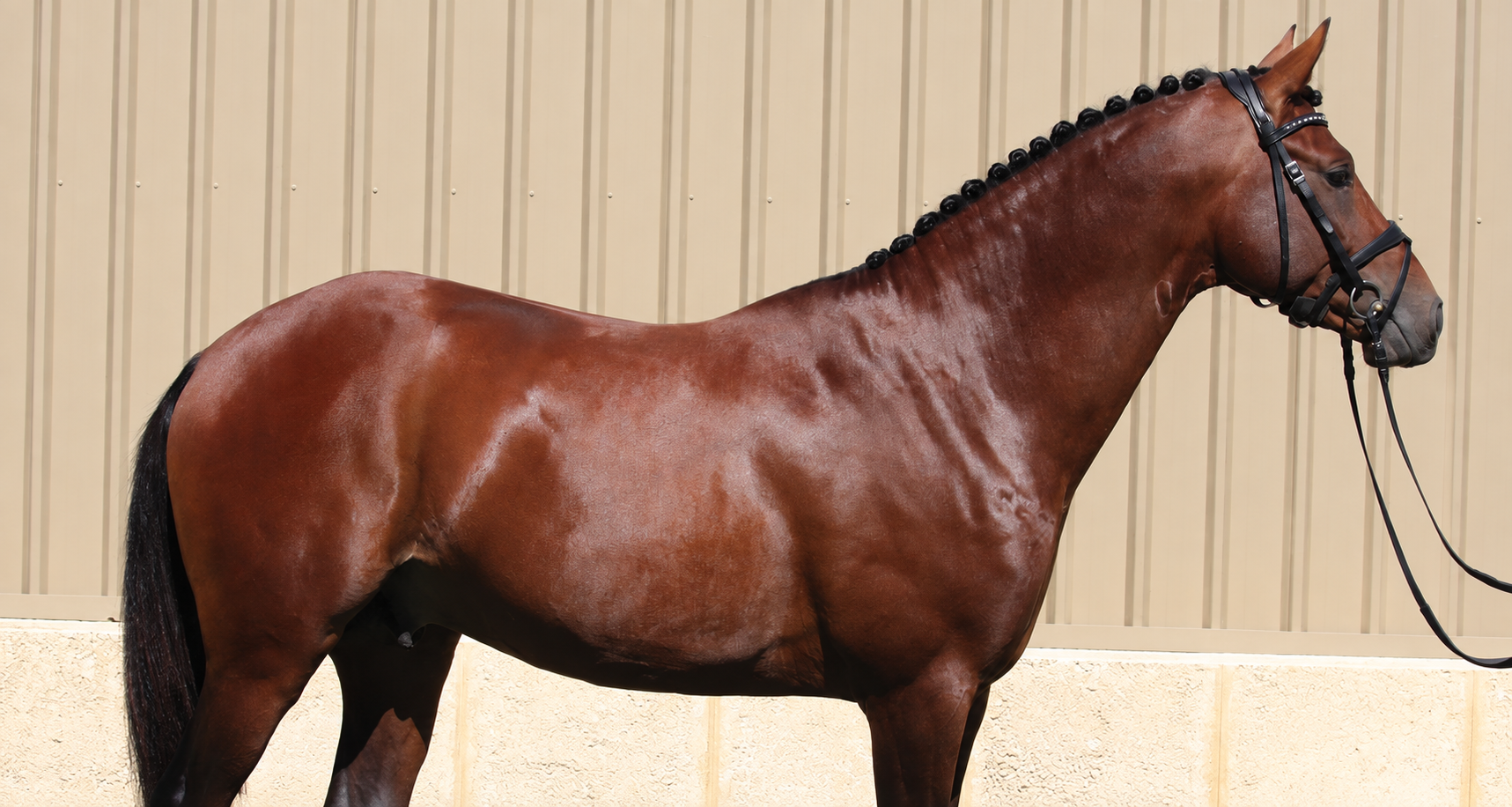
A stronger topline is built through movement, not appearance. While a rounded neck is often associated with correct work, it does not necessarily reflect genuine postural development. The muscles of the neck and back do not develop optimally simply because the head is carried in a particular position. They strengthen most effectively when the horse learns to coordinate the hindquarters, trunk, thoracic sling, and neck as one integrated system.
That distinction matters. A horse can look "in a frame" while still bracing the underside of the neck, dropping the back, or moving with limited reach and self-carriage. Lasting topline development comes from improved movement quality and coordination, not from holding the horse in a shape. As balance, strength, and whole-body function improve, the topline develops as a result.
Start with rhythm and balance
Before asking for more elevation or collection, the horse needs a rhythm they can maintain without rushing, slowing, or losing alignment. A consistent tempo gives the nervous system time to organize each stride and allows the back to move rather than brace.
Large circles, shallow loops, changes of direction, and frequent transitions can help, provided the horse stays relaxed and the exercise remains within their current ability. The best exercise is not the most difficult one; it is the one the horse can perform with improving coordination.
Develop the trunk and thoracic sling
The topline is influenced by how well the horse supports the trunk between the shoulders. When the thoracic sling is working effectively, the withers can lift and the neck can lengthen forward from a more stable base.
Thoughtful transitions, poles, hills, and work in hand can encourage this organization. Each tool should be introduced gradually and selected for the individual horse. More repetitions are not automatically better if fatigue changes the quality of movement.
Let the neck be an outcome
Rein contact can guide direction and connection, but pulling the head into place does not create the strength needed to sustain that position. Instead, look for a neck that can lengthen and adjust as the horse’s balance changes. The poll, jaw, and base of the neck should remain responsive rather than fixed.
A useful question is whether the horse can maintain rhythm, steering, and balance when the rider softens. If the posture disappears immediately, the horse may still be relying on the rider’s hand rather than carrying the organization independently.
Build capacity slowly
Muscle and coordination need recovery time. Short periods of high-quality work, separated by walk breaks or a change of task, are usually more productive than drilling until the horse is tired. Over weeks and months, the horse should become able to maintain the same quality for longer without losing relaxation.
Track changes in symmetry, willingness, recovery, and ease of movement, not only appearance. Persistent soreness, a sudden change in performance, or an asymmetry that does not improve should be discussed with the horse’s veterinarian before increasing the workload.
Topline reflects the whole program
Training cannot be separated from saddle fit, hoof balance, nutrition, turnout, recovery, and comfort. When those pieces support the horse, progressive gymnastic work can develop a topline that reflects genuine carrying strength.
With time, the horse can move with greater balance, lift, freedom, and confidence while sustaining that organization independently.
Back to all insights