
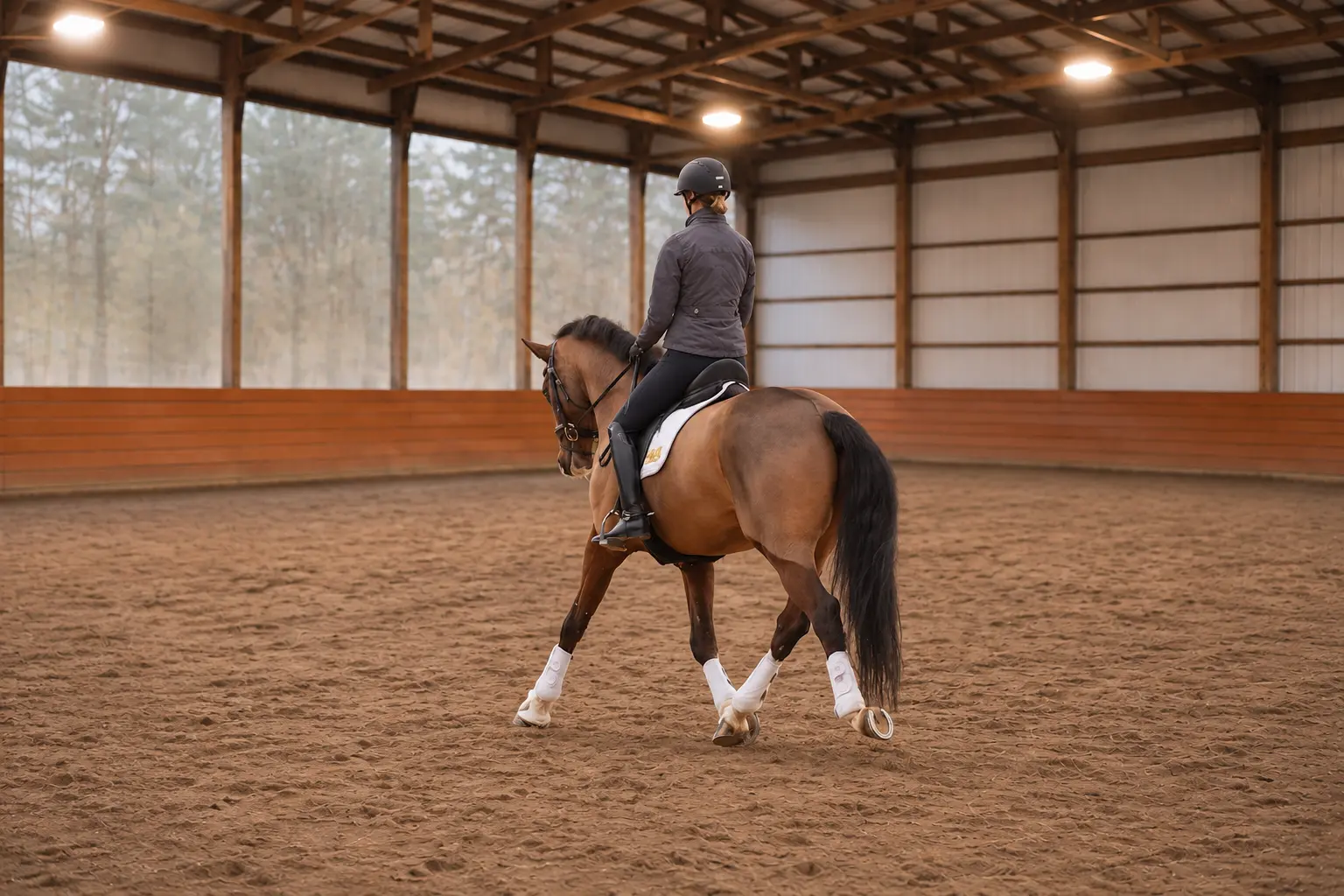
Riders often focus on straightening the horse: keep the shoulders aligned, control the haunches, and ride evenly into both reins. But the horse is responding to the balance of the person in the saddle.
If the rider consistently carries more weight to one side, shortens one leg, or uses one rein differently, the horse must organize around that asymmetry. Straightness begins with understanding what the rider is contributing.
Uneven weight changes the horse’s path
A rider who sits more heavily on one seat bone may unintentionally ask the horse to drift, bend, or load one side differently. The effect can be subtle, especially when the pattern feels normal to the rider.
Trying to force equal weight rarely helps. A better starting point is noticing whether the rib cage is centered over the pelvis and whether both feet feel equally supported in the stirrups.
Leg position affects more than the aids
One leg may creep forward, draw upward, or brace more strongly than the other. This changes the rider’s pelvis and can create conflicting information for the horse.
The goal is not to make both legs look identical. It is to develop a functional position in which each leg can give an aid and then soften without disturbing the rider’s balance.
The reins often reveal the pattern
Uneven rein contact is not always a hand problem. One hand may feel stronger because the rider’s torso is rotated, one shoulder is carried forward, or the pelvis is displaced to the opposite side.
Before adjusting the reins, check the larger picture:
- Are both shoulders facing the same direction as the horse’s shoulders?
- Is one elbow held farther from the body?
- Does one hand cross the neck or pull backward?
- Can both hands follow the horse’s movement independently?
Build awareness before making corrections
Small observations are more useful than trying to become perfectly symmetrical. Ride a familiar line and notice where your weight changes. Compare both directions. Ask what happens to your leg and hand position before the horse begins to drift.
Video can also be valuable because what feels centered may not yet look centered. A trainer can help separate the rider’s pattern from the horse’s pattern and choose corrections that improve both.
Straightness is a shared process
Neither horse nor rider is perfectly symmetrical. The aim is not rigid sameness, but better coordination: a rider who can recognize imbalance, make a clear adjustment, and return to following the horse.
As the rider becomes more centered and consistent, the horse receives quieter information and has a better opportunity to travel straight.
Back to all insights