
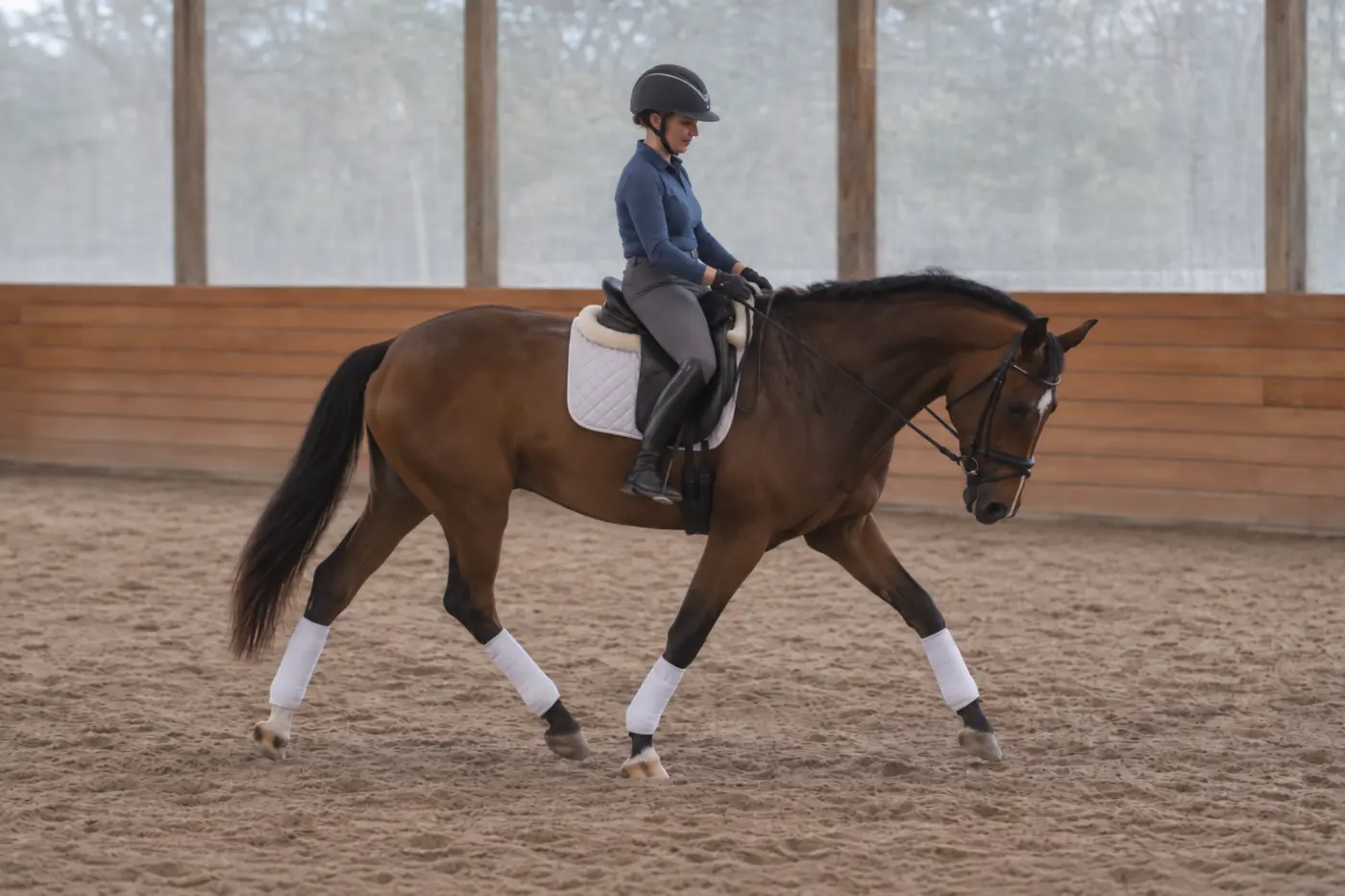
Adult amateur riders are often asked to learn several things at once: organize their own bodies, understand a new exercise, time the aids, and interpret a horse who may also be learning. That can make even a straightforward lesson feel complicated.
A good schoolmaster changes the equation. An experienced horse cannot do the learning for the rider, but can make the correct answer easier to feel.
Feel is learned through experience
Riders hear phrases such as “follow the motion,” “support the outside shoulder,” or “wait with the hand.” The words matter, but they become useful only when the rider can connect them to a physical sensation.
A schoolmaster offers a more consistent response. When the rider improves the timing of an aid, the horse often answers clearly. That immediate feedback helps the rider recognize what worked and begin to reproduce it.
Confidence creates room to learn
Many adults ride with understandable caution. They may be returning after time away, rebuilding after a fall, or balancing riding with bodies that no longer recover as quickly as they once did. A predictable, well-educated horse gives the rider space to breathe, listen, and experiment without feeling that every mistake will escalate.
Confidence is not the absence of challenge. It is the sense that the challenge is manageable. From that place, riders can make smaller adjustments and develop more refined skills.
A schoolmaster reveals the rider’s habits
An experienced horse is not an automatic horse. Schoolmasters often expose unclear aids with great honesty. If the rider braces, leans, or gives conflicting signals, the horse may simply continue doing what was already happening.
This feedback is valuable. It shifts the question from “Why won’t the horse do it?” to “What information am I giving?” That habit of inquiry is central to thoughtful riding.
Timing becomes more understandable
Correct aids are not only about strength or position; they are about when the aid is given and when it is released. A schoolmaster can help a rider feel the moment a transition becomes available, the instant a half halt has been understood, or the difference between supporting a movement and continuing to push after the horse has answered.
Learning to release is especially important. The rider begins to discover that clarity often comes from doing less at the right moment.
The goal is independence
The purpose of riding a schoolmaster is not to avoid less experienced horses forever. It is to build a reliable library of sensations that the rider can carry to other horses.
Once a rider has felt a balanced transition, an elastic contact, or a truly swinging back, it becomes easier to recognize when those qualities are developing and when they are missing. That experience makes the rider a clearer partner for every horse that follows.
Back to all insights