
Learning classical dressage as an adult amateur rider comes with unique rewards and challenges. You're balancing work, family, and personal commitments, which means your time in the saddle needs to be efficient, clear, and impactful. You aren't looking for vague advice like "just feel it." You want to understand the physical mechanics of why an aid works and how your body affects your horse's movement.
Biomechanical analysis, available through virtual lessons or in person, gives you a powerful tool to accelerate your learning. What's particularly helpful for the adult learner is recording your lesson or ride for expert analysis and review on your own time. By combining video review with biomechanical coaching, you can break down complex movement concepts and see rapid improvements in your riding.
Why adult riders benefit from reviewing their rides
Children often learn athletic skills by copying what they see without overthinking it. Adult brains work differently. You learn best through explicit instruction, where you can visualize the movement, analyze cause and effect, and process clear feedback.
When you're in the saddle, what you feel doesn't always match reality. You might feel like your shoulders are straight, only to discover on camera that you're collapsing to the inside on every circle.
Biomechanical video review bridges the gap between feel and reality. Reviewing ride footage frame by frame on your own schedule allows you to:
- Build an accurate mental image: Seeing your body position on screen helps you map physical corrections to real visual feedback.
- Identify subtle rider habits: You can spot where unintended tension in your wrists, knees, or lower back interferes with the horse.
- Understand the horse's response: Watching how your horse's back, neck, and hind legs react to your aids makes the logic of classical dressage obvious.
How biomechanical analysis works
Biomechanical analysis through virtual lessons requires a horse to ride at your home facility or barn, making it ideal for adult amateurs who lease or own a horse locally but want high-level coaching from a distance.
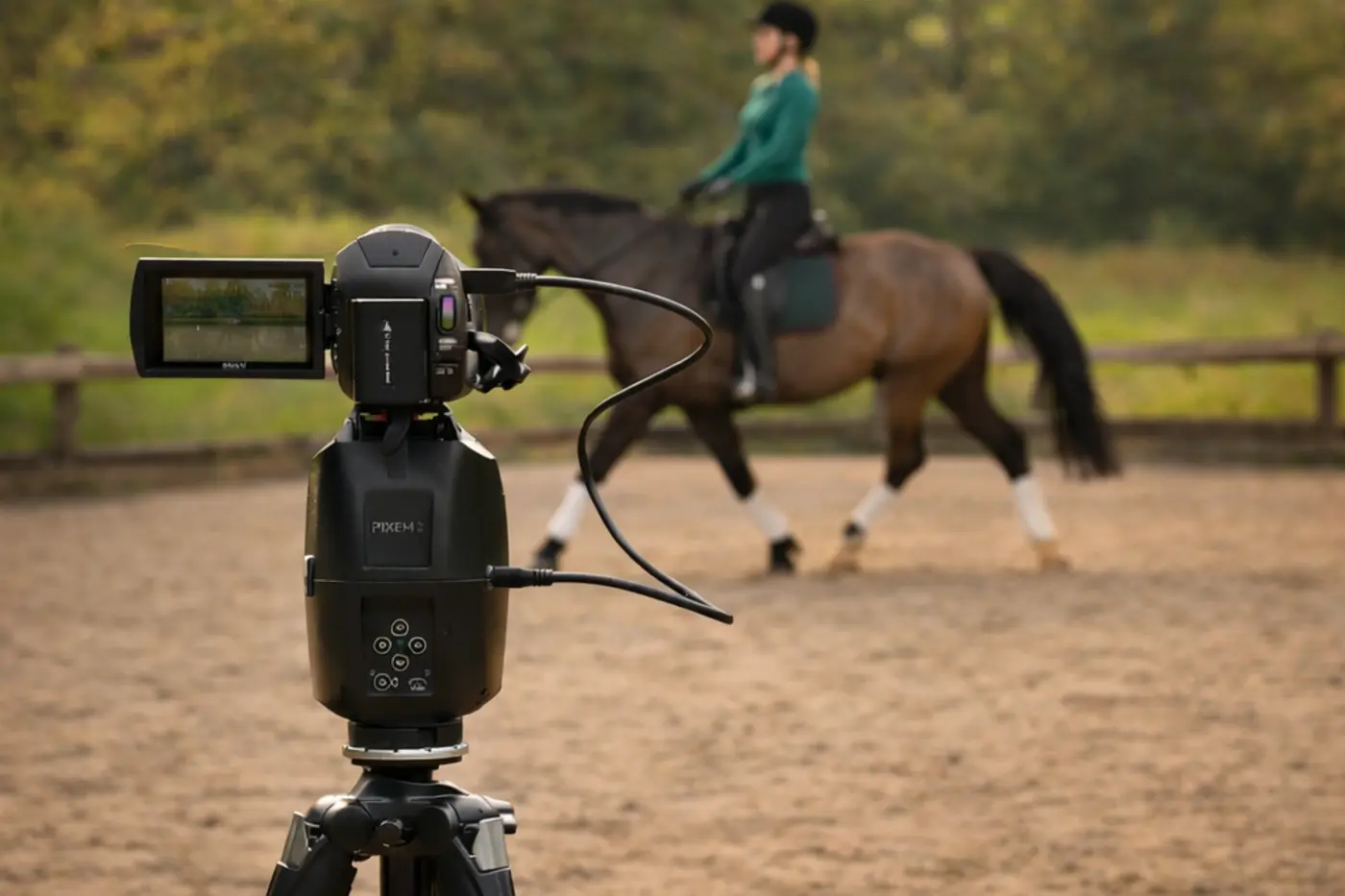
Simple tech to record your rides
Modern camera technology makes capturing high-quality ride footage at your home barn easier than ever:
- Auto-tracking camera mounts: Devices like the Pivo Pod mount to a standard tripod and use smart tracking to keep you and your horse centered in the frame automatically.
- Dedicated equestrian tracking systems: High-end setups like the PIXEM 2 offer precise, long-range tracking designed specifically for large riding arenas.
Once you record your ride or lesson, you can review the detailed, frame-by-frame analysis at your own pace whenever it fits your schedule.
Connecting rider position to equine biomechanics
Small shifts in your posture significantly alter force distribution across the horse's back. Learning how your weight impacts movement makes you a more effective, compassionate rider for your horse.
Research highlights how directly a rider's posture influences the horse. In the scientific review Riders’ Effects on Horses—Biomechanical Principles with Examples from the Literature, researchers show how rider weight distribution, pelvic alignment, and symmetry affect the horse's stride length, spinal movement, and joint balance.
When you use biomechanical analysis to correct your seat, you stop accidentally blocking your horse's movement and start inviting relaxed, fluid gaits.
Master classical dressage with Seven Hills Training
At Seven Hills Training, we tailor our instruction specifically to how adult amateurs learn. We specialize in classical dressage and equine biomechanics, offering a supportive, low-drama environment where you can ask questions, break down mechanics, and make steady progress.
Whether you're joining us for in-person lessons in Monroe, WA, or utilizing our biomechanical analysis through virtual lessons from your home barn, we'll help you develop a deeper understanding of your position and aids so you can bring out the best in your horse.
Ready to elevate your riding through biomechanical understanding? Visit Seven Hills Training to explore our lesson and virtual coaching options today.
Back to all insights