
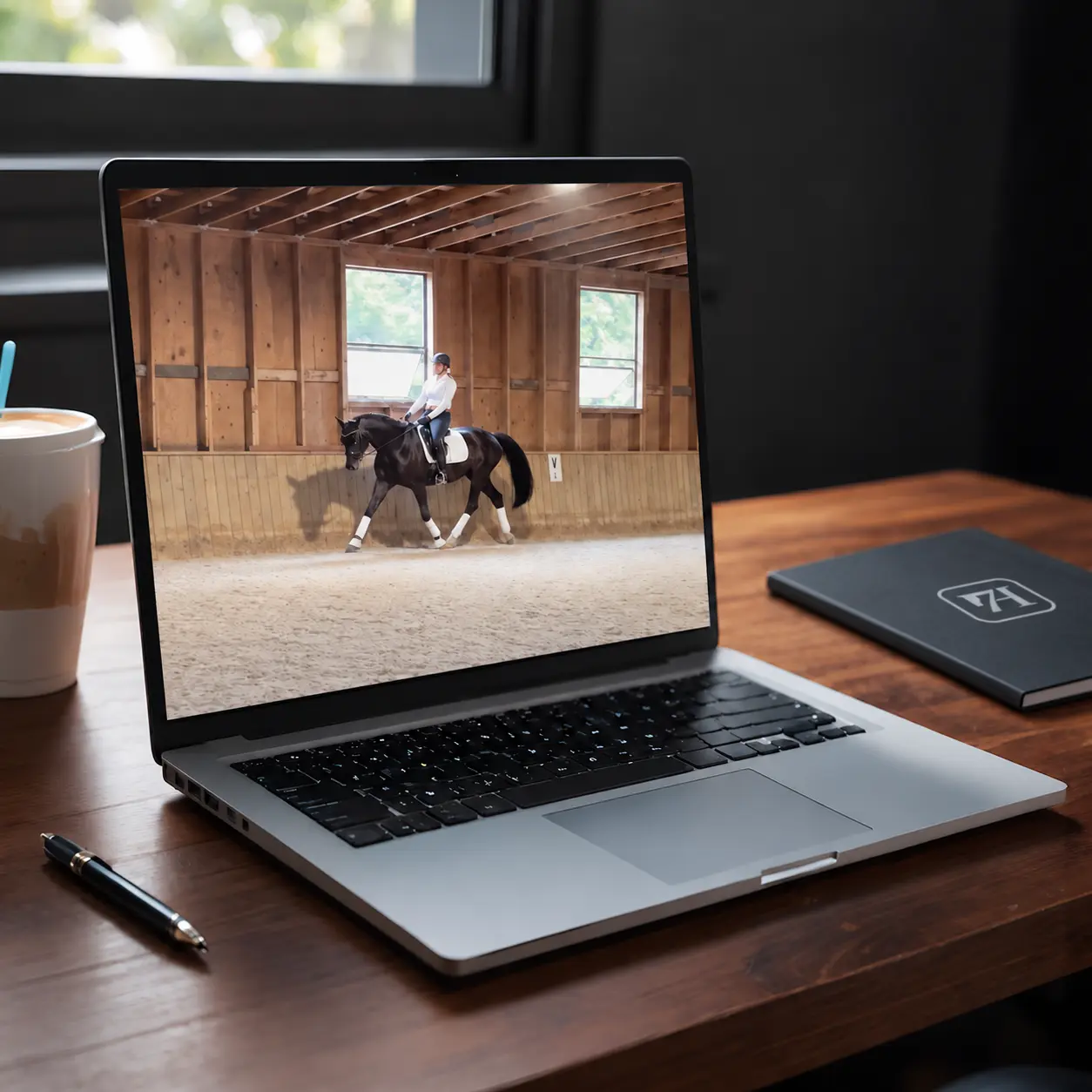
What a rider feels in the saddle is real, but it is not always a complete picture. Familiar patterns can feel centered. A quick correction can feel much longer than it looks. A horse that seems rushed may actually be losing balance only at one point in an exercise.
Video gives rider and trainer another perspective. It does not replace feel; it helps calibrate it.
The moments before the problem
Riders naturally notice the obvious moment: the missed transition, the crooked halt, or the loss of rhythm. A trainer reviewing video can slow the sequence down and identify what happened several strides earlier.
Perhaps the rider tipped forward during the preparation, the outside rein became fixed, or the horse drifted before the aid was given. Seeing the lead-up turns a vague problem into something the rider can address.
Alignment that feels normal
A rider may feel evenly weighted while consistently sitting to one side. One hand may appear higher because the torso is rotated, or one leg may brace because the pelvis has shifted. These habits are difficult to identify from feel alone precisely because they are familiar.
Video makes the pattern visible. The goal is not to criticize the rider’s position frame by frame, but to find the adjustment that improves function: a more centered rib cage, a softer hip, or a hand that can follow instead of hold.
How the horse responds
Video also helps connect the rider’s actions to the horse’s movement. A trainer may see the back stiffen when the rider drives harder, the neck shorten when the contact becomes fixed, or the stride improve when the rider allows more time.
That cause-and-effect relationship is powerful. It shows the rider that better movement is not created by arranging the horse’s outline, but by improving the conversation between both bodies.
Patterns across the whole ride
A single moment can be misleading. Reviewing a longer sequence reveals whether a difficulty appears in one direction, during a particular transition, after fatigue, or whenever the rider introduces a certain exercise.
These patterns help the trainer distinguish between a skill that needs practice, a task that should be simplified, and a change that may warrant further assessment.
Turn observation into one useful change
The most effective video feedback is specific and manageable. Rather than giving the rider ten corrections, a trainer can identify one or two priorities and explain what to notice during the next ride.
Over time, the rider’s internal sense begins to match what is visible on screen. That is the real value of video: not learning to ride for the camera, but developing more accurate feel when the camera is no longer there.
Back to all insights